Momentum is a fundamental concept in physics that describes the quantity of motion an object has. It is a vector quantity, meaning it has both magnitude and direction, and it is directly proportional to both the mass and velocity of the object.
Definition
Momentum: The product of an object’s mass and its velocity. It is denoted by the symbol ppp.
Formula
p=m⋅vp = m \cdot vp=m⋅v
Where:
- ppp is the momentum,
- mmm is the mass of the object,
- v is the velocity of the object.

Key Characteristics of Momentum
- Vector Quantity: Momentum has both magnitude (how much momentum) and direction (the direction of the object’s motion).
- SI Unit: The standard unit of momentum in the International System of Units (SI) is kilogram meter per second (kg·m/s).
- Dependence on Mass and Velocity: An object’s momentum increases with greater mass and/or higher velocity.
Conservation of Momentum
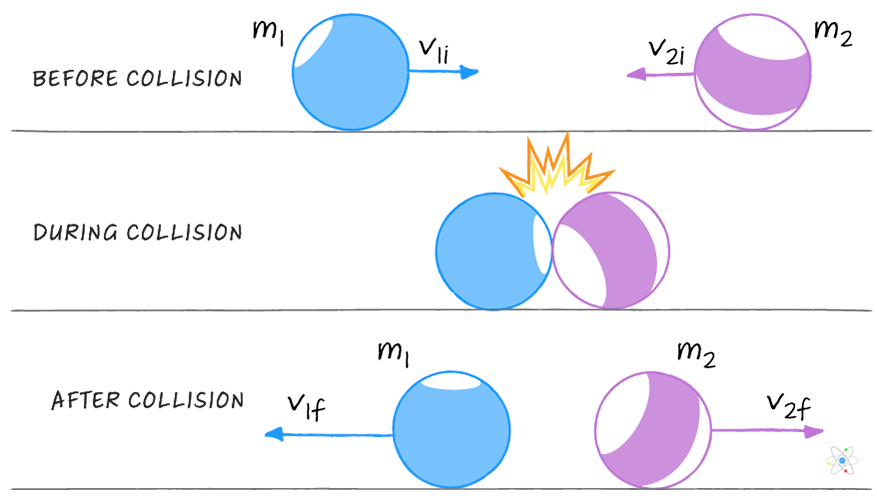
One of the fundamental principles associated with momentum is the law of conservation of momentum, which states that the total momentum of a closed system is conserved if no external forces act on it. This means that the total momentum before an interaction (such as a collision) is equal to the total momentum after the interaction.
Types of Collisions
- Elastic Collisions: Both momentum and kinetic energy are conserved. Objects bounce off each other without any loss of energy.
- Inelastic Collisions: Momentum is conserved, but kinetic energy is not. Objects may stick together or deform, resulting in a loss of kinetic energy.
Examples
- Moving Car: A car with a mass of 1,000 kg traveling at a velocity of 20 m/s has a momentum of 1,000 kg×20 m/s=20,000 kg⋅m/s1,000 \, \text{kg} \times 20 \, \text{m/s} = 20,000 \, \text{kg} \cdot \text{m/s}1,000kg×20m/s=20,000kg⋅m/s.
- Billiard Balls: When two billiard balls collide, their total momentum before and after the collision remains constant, assuming no external forces like friction act significantly on them.
Impulse
Impulse is closely related to momentum and describes the change in momentum of an object when a force is applied over a period of time. It is given by the formula: J=F⋅tJ = F \cdot tJ=F⋅t
Where:
- JJJ is the impulse,
- FFF is the force applied,
- ttt is the time duration over which the force is applied.
The impulse experienced by an object is equal to the change in its momentum: J=ΔpJ = \Delta pJ=Δp

Importance of Momentum
Momentum is a key concept in understanding motion and dynamics. It helps in analyzing and predicting the outcomes of collisions and interactions in various physical systems, from everyday objects to complex astrophysical phenomena.
In summary, momentum is a measure of the motion of an object, directly related to its mass and velocity. Its conservation is a fundamental principle in physics, providing a powerful tool for understanding and analyzing dynamic systems.
4o