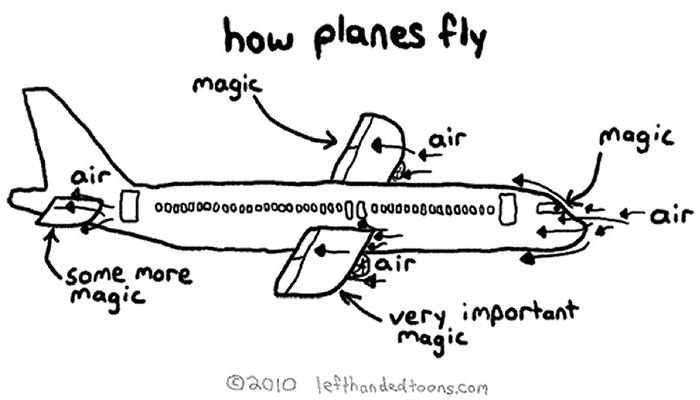
Aeroplanes fly by balancing four physical forces through a combination of engine power and wing design. This process is governed by fundamental physics principles, primarily Bernoulli’s Principle and Newton’s Laws of Motion.
1. The Four Forces of Flight
To stay in the air, a plane must constantly manage these four forces:
- Thrust: The forward force created by engines or propellers that moves the plane through the air.
- Drag: The backward force of air resistance that slows the plane down.
- Weight (Gravity): The downward force pulling the plane toward Earth.
Building on the basics, the physics of flight involves several deeper but easy-to-understand concepts.
1. Advanced Wing Mechanics
Wings aren’t just static shapes; they are dynamic tools that change during different stages of flight:
- Angle of Attack: This is the angle at which the wing meets the oncoming air. Increasing this angle generates more lift, but tilting too sharply can lead to an Aerodynamic Stall, where the air becomes turbulent and the wing stops flying.
- Flaps and Slats: During takeoff and landing, pilots extend these panels to increase the wing’s surface area.