Waves and motion!
Types of Waves:
- Mechanical Waves: require a medium (solid, liquid, gas)
- Longitudinal Waves (compression)
- Transverse Waves (perpendicular)
- Electromagnetic Waves: no medium required
- Radio Waves
- Microwaves
- Infrared Radiation
- Visible Light
- Ultraviolet Radiation
- X-rays
- Gamma Rays

Wave Motion:
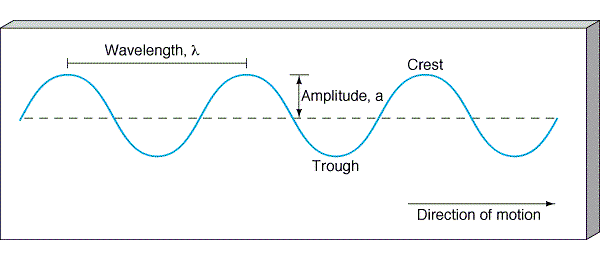
- Frequency (f): oscillations per second (Hz)
- Wavelength (λ): distance between two consecutive peaks/troughs (m)
- Speed (v): distance traveled per second (m/s)
- Amplitude (A): maximum displacement from equilibrium
- Period (T): time for one oscillation (s)
Wave Equations:
- Wave Equation: ∂²u/∂t² = c²∇²u
- Frequency-Wavelength Relation: f = c/λ
- Speed-Frequency Relation: v = λf
Types of Motion:
- Simple Harmonic Motion (SHM)
- Damped Motion
- Forced Motion
- Resonance
- Oscillations
Real-World Applications:
- Sound Waves: music, speech, ultrasound
- Light Waves: vision, optics, communication
- Water Waves: oceanography, surfing, shipping
- Seismic Waves: earthquake science, geology
- Medical Imaging: MRI, CT scans

Key Concepts:
- Wave-Particle Duality
- Interference
- Diffraction
- Refraction
- Reflection