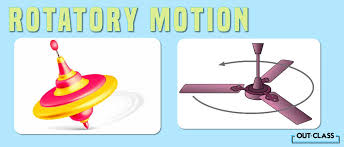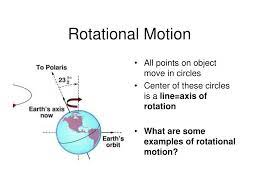
Circular and rotational motion are fundamental concepts in physics, describing how objects move in a circular path or rotate around an axis. Let’s break down these concepts:

1. Circular Motion
Circular motion refers to the movement of an object along the circumference of a circle. This motion can be uniform or non-uniform.
- Uniform Circular Motion: The object moves along the circular path with a constant speed. While the speed remains constant, the direction of the velocity changes continuously, resulting in acceleration towards the center of the circle. This acceleration is called centripetal acceleration.
- Centripetal Acceleration (aca_cac): Given by ac=v2ra_c = \frac{v^2}{r}ac=rv2, where vvv is the linear speed of the object and rrr is the radius of the circle.
- Centripetal Force (FcF_cFc): The net force causing centripetal acceleration, given by Fc=m⋅ac=m⋅v2rF_c = m \cdot a_c = \frac{m \cdot v^2}{r}Fc=m⋅ac=rm⋅v2, where mmm is the mass of the object.
- Non-uniform Circular Motion: The speed of the object varies along the circular path, leading to both tangential and centripetal accelerations.
2. Rotational Motion
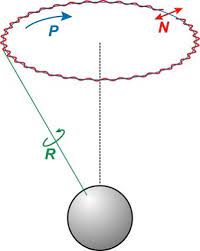
Rotational motion describes the movement of an object around an internal or external axis. In this case, different points in the object follow circular paths.
- Angular Displacement (θ\thetaθ): The angle through which a point or a line has been rotated in a specified sense about a specified axis.
- Angular Velocity (ω\omegaω): The rate of change of angular displacement, given by ω=dθdt\omega = \frac{d\theta}{dt}ω=dtdθ. It is measured in radians per second (rad/s).
- Angular Acceleration (α\alphaα): The rate of change of angular velocity, given by α=dωdt\alpha = \frac{d\omega}{dt}α=dtdω. It is measured in radians per second squared (rad/s²).
- Moment of Inertia (III): The rotational equivalent of mass in linear motion, representing the distribution of an object’s mass relative to its axis of rotation. For a point mass, it is given by I=m⋅r2I = m \cdot r^2I=m⋅r2, where mmm is the mass and rrr is the distance from the axis of rotation.
- Torque (τ\tauτ): The rotational equivalent of force, it causes an object to rotate. It is defined as τ=r⋅F⋅sinθ\tau = r \cdot F \cdot \sin\thetaτ=r⋅F⋅sinθ, where rrr is the lever arm (distance from the axis), FFF is the force applied, and θ\thetaθ is the angle between the force vector and the lever arm.
- Rotational Kinetic Energy: The energy due to rotational motion, given by KErot=12Iω2\text{KE}_{\text{rot}} = \frac{1}{2} I \omega^2KErot=21Iω2.
These concepts are critical in understanding the dynamics of systems in physics, from simple toys to celestial bodies. If you have specific questions or need more detailed explanations, feel free to ask!