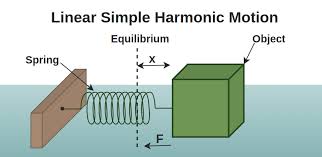
Simple Harmonic Motion (SHM) is a type of periodic motion where an object oscillates back and forth around an equilibrium position. The motion is characterized by a restoring force that is directly proportional to the displacement from the equilibrium position and acts in the opposite direction. This restoring force causes the object to accelerate back toward the equilibrium position, resulting in an oscillatory motion.
Key Characteristics of SHM:
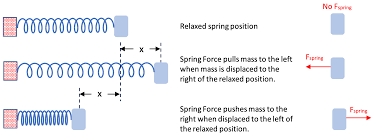
- Restoring Force: The force responsible for SHM is given by Hooke’s Law: F=−kxF = -kxF=−kx, where:
- FFF is the restoring force,
- kkk is the force constant (or spring constant in the case of a mass-spring system),
- xxx is the displacement from the equilibrium position.
- Equation of Motion: The motion can be described by the differential equation:d2xdt2+ω2x=0\frac{d^2x}{dt^2} + \omega^2 x = 0dt2d2x+ω2x=0where ω\omegaω is the angular frequency of the motion, and x(t)x(t)x(t) is the displacement as a function of time.

- Solution to the Equation: The general solution to this differential equation is:x(t)=Acos(ωt+ϕ)x(t) = A \cos(\omega t + \phi)x(t)=Acos(ωt+ϕ)where:
- AAA is the amplitude of oscillation (maximum displacement),
- ω\omegaω is the angular frequency, ω=km\omega = \sqrt{\frac{k}{m}}ω=mk,
- ttt is the time,
- ϕ\phiϕ is the phase constant, determined by the initial conditions.
- Period and Frequency:
- The period TTT is the time it takes for the object to complete one full cycle of motion and is given by T=2πωT = \frac{2\pi}{\omega}T=ω2π.
- The frequency fff is the number of oscillations per unit time and is given by f=1T=ω2πf = \frac{1}{T} = \frac{\omega}{2\pi}f=T1=2πω.

- Energy in SHM:
- The total mechanical energy in SHM is conserved and is the sum of potential and kinetic energies.
- The potential energy is U=12kx2U = \frac{1}{2} kx^2U=21kx2.
- The kinetic energy is K=12mv2K = \frac{1}{2} mv^2K=21mv2, where v=dxdtv = \frac{dx}{dt}v=dtdx.
- The total energy EEE is constant and equals E=12kA2E = \frac{1}{2} kA^2E=21kA2.
Examples of SHM:
- A mass attached to a spring and oscillating back and forth.
- A simple pendulum (for small angles).
- The oscillation of atoms in a crystal lattice.
SHM is a fundamental concept in physics, with applications ranging from mechanical systems to electrical circuits and even quantum mechanics.